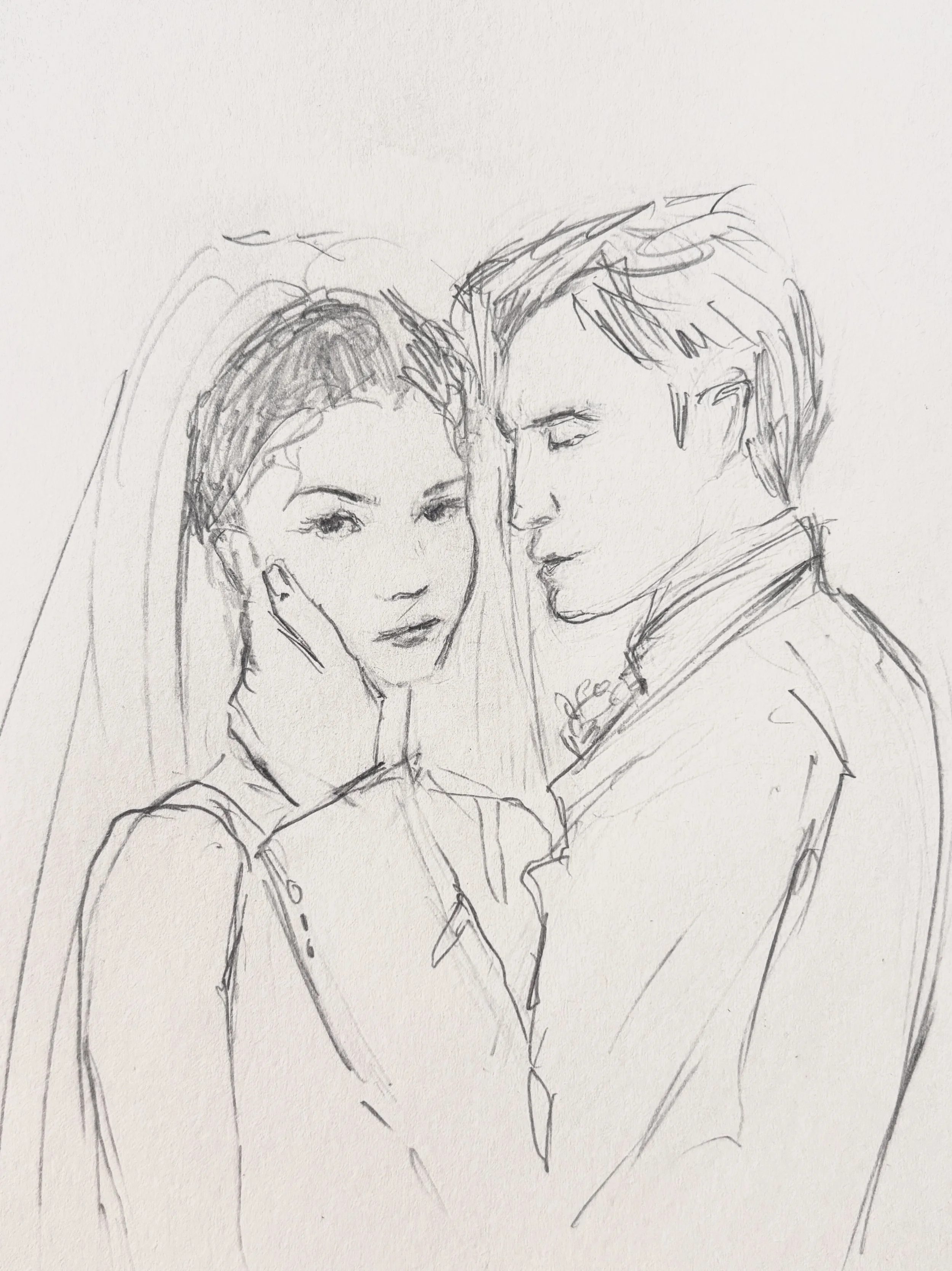
The Drama (2026), Iris Yu
Can You Forgive Her? The Sickly Stylishness of The Drama
Eleanor Polak
It’s a classic case of boy-meets-girl: Charlie (Robert Pattinson) sees Emma (Zendaya) at a coffee shop, where she’s busy reading a novel and looking pretty. He approaches her, pretending to have read the book; she appears to ignore him, causing him to spiral. Once he finally gets her attention, Emma explains that she hadn’t heard him because she’s deaf in one ear, and had an earbud in the other. He apologizes, they laugh, and they get the chance to start the interaction over. Cute, right? Just you wait.
Kristoffer Borgli’s The Drama has a straightforward concept: it tracks the lives and emotions of a couple during the week leading up to their wedding day. There’s a kind of classic simplicity to the story, enforced by the architecture of the film: clean, elegant interiors; wooden wall panels; spiral staircases; and laden bookshelves. Zendaya and Pattinson are, of course, plenty pretty to look at, and the movie relies heavily on their obvious attractiveness and almost unrelenting charm. Borgli wants you to want to live inside this world, to inhabit these luxurious apartments, to experience the lives of these perfect people. He treats every scene like a wedding shoot, complete with artfully posed characters and dainty detail shots. The colours are cool but inviting, clean but not sterile. By the time a rivulet of blood makes its way across the scene, it barely registers as shocking.
At risk of ruining the “twist” that occurs about twenty minutes into The Drama, Emma and Charlie have a lot more to worry about than some spattered blood. At a dinner with their married friends Mike (Mamoudou Athie) and Rachel (Alana Haim), the group decides to play a pre-wedding game: they go around the table and tell each other the worst things they’ve ever done. At first it’s all drinking and incredulous laughing and revelations of past sins that get brushed over pretty easily—until it’s Emma’s turn. She confesses that when she was fifteen, she planned and came close to executing a school shooting. And then she watches as the laughter dies on her friends lips, and as her fiancé's look of love curdles into horror.
From then on, the film focuses mostly on Charlie, as he reacts—whether he overreacts or underreacts is left for audience speculation——to the realisation that the woman he loves has a dark past; a history that forces him to reevaluate his perception of her. Painfully tense scenes of confrontation between the two of them are interspersed with lavish, violent fantasy sequences and grainy flashbacks to young Emma (Jordyn Curet)’s childhood. The Drama is, in fact, a drama, but it’s also a queasy comedy—emphasis on “queasy.” Much is made, for example, of the double meaning of the word “shoot”: a gun, or a camera? Yet, despite the acknowledgement of the inherent life-or-death stakes of film as a medium, Borgli seems largely uninterested in taking his subject matter seriously. He plays out the plot like a kind of half-joking hypothetical: what would you do if your partner…? The Drama becomes an exercise in dark what ifs—an exercise that, while pretty to look at, belies the point or seriousness of its subject matter.
“I was interested in the aesthetics of school shootings,” Emma tells Charlie, her voice breaking a little bit, desperate to make him understand, or just to leave her alone. “It was a whole thing online, and I just thought it looked cool.” The line opens the door to a discussion about the romanticization of violence targeted towards teenagers in the United States, but Borgli doesn’t take the time or effort to go into it any deeper. He, too, appears to be only interested in the aesthetics of school shootings—that, and using them as a shock-value punch line. In another scene, a reference to the fact that gun violence is a very current, very American issue is shrugged off as a quip about Charlie being English. The movie is uninterested in unpacking why a fifteen-year-old girl would want to kill her classmates. After all, that’s not pretty, and it’s not funny either. Charlie is the only character who displays any real desire to understand Emma’s perspective, and even then, he’s less interested in explaining it than in explaining it away.
A large part of the problem is that Zendaya (a phenomenal actress, who depicts Emma with more gravitas and tenderness than the script itself really deserves) isn’t given all that much to do. Borgli appears far more interested in Charlie and his male-anxieties than Emma and her female-complexities. He lets Pattinson explore Charlie in depth—every nuance of his emotional journey, through all seven stages of grief and then back again—but relies on Zendaya’s admittedly very emotionally expressive face to do the heavy lifting of conveying Emma’s feelings. The result is a film that has almost nothing to do with gun violence, and everything to do with one man’s pre-wedding jitters.
The film might also be saying something about the performative nature of weddings themselves, and how they—especially in the age of social media—demand that private love become a public display. Borgli gestures towards that theme early on, with a choreographer who tells Emma that “it’s a wedding, it’s performative by nature,” but never really follows through. It’s much more fun to throw in a shot of Zendaya in a bloody wedding dress and call it social commentary. Or to see how many times you can make a visual pun out of the phrase “shotgun wedding” without ever outright saying it.
The Drama is nice to look at, sure, but it’s all style over substance. Borgli takes a fascinating and socially relevant premise, and turns it into an extended bit, like a newlywed game gone wrong. This should be a movie about love, and forgiveness, and whether or not redemption is ever even possible. Instead, you leave the theatre feeling adrenalized but a little bit sick to the stomach, like a wedding guest who overdid it on champagne and sugary cake. It’s glamorous, but not nourishing. The architecture of these characters’ lives might look like something out of London Vogue, but the reality is, it'd collapse under any real weight.
You might want to try and live inside it anyway, though. That apartment is really nice….
Eleanor Polak is a Senior Editor at the literary magazine Conjunctions, and an undergraduate student at Bard College where she is studying in the Written Arts program. She is also a research assistant for the novelist Bradford Morrow.