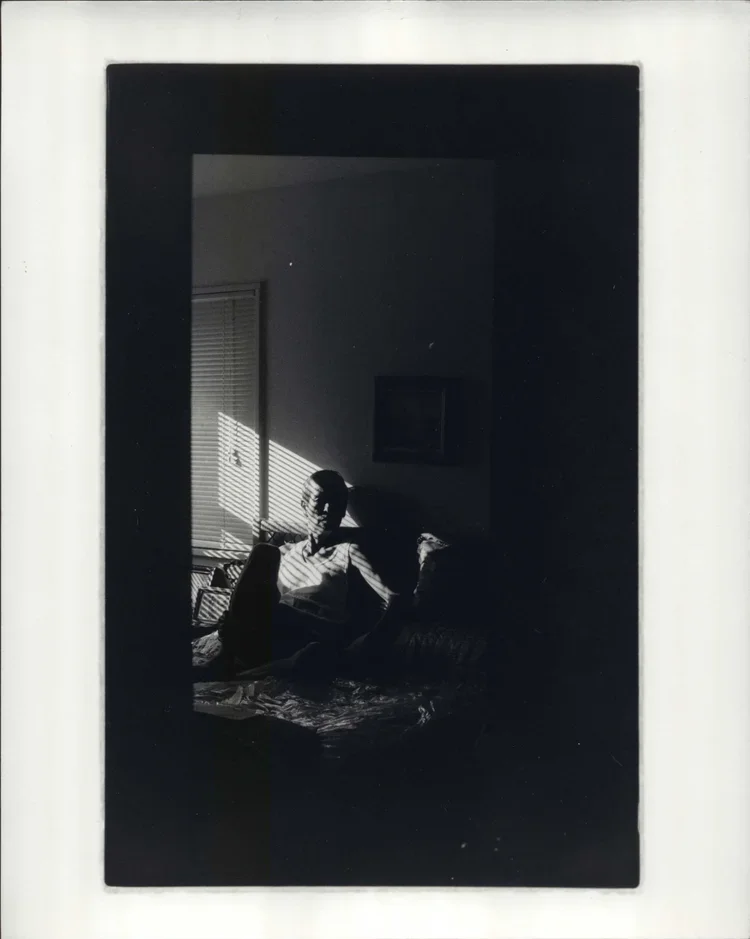
Poppo in the Master Bedroom (2025), Caroline Cavalier
SEAMS
FLORENCE ASHLEY
Two decades passed before me and the memory never ceased haunting me. The more I seek to cast it out from consciousness, the more it presses itself upon me. It is as though a force wishes to curse me with remembrance.
I began my career employed as a psychiatrist at Saint-Paul de Mausole. The locale was mandated upon my graduation, no other being in want of my novice skills. Of the work, I remember little but one patient—today, perhaps the only patient that I can conjure to mind. My memory is not what it once was.
The patient’s name was Hector. He had been transferred to us from Salpêtrière, where he was once committed by his family. Whatever his relationship was to them, I cannot recall ever a visit from them—nor a friend. He came to us atterré by psychosis after the death of his sister by his own hand, a mode of the family. He had been found arched over her cadaver, his hands in the deep stain of her chest, which had been pried apart with such brutality and force that an animal was briefly suspected. Of course, someone quickly reminded the gendarmes that no such animal lived in third-floor Parisian apartments. I have once or twice overheard staff say that the sister’s heart was missing, that the poor man may have eaten it. I paid no mind to the gossip, undesirous to taint my impression of our new patient.
He was soon assigned to my care. He did not exude the energy of the others who arrived on our doorstep. Our first meeting was lucid, more reminiscent of a colleague than a patient. It felt as though speaking to a mirror, though I suspect that even I would not perform with such ease in the disorienting space of the asylum, forced upon by powerful, dreary opiates.
When I first broached the topic of his sister, some sessions later, I saw his eyes widen yet little understanding. Centrepiece amidst his eyelids, his irises gleamed under the overhead light before darkening under his furrowing brow.
“It was a tragic affair. Some days, it keeps me up at night,” he explained in a monotonous voice. “My memories of Hélène are faint; lately, I have been growing distraught at my fading memories of her existence. I am losing my grasp of her. You must understand, Marie, that I barely had a chance to know her. She lived in Aix-en-Provence with my grandfather for the first four years of her life, too frail had she been to depart for Paris with us. With my excitement, she was eventually allowed to rejoin us but, tragically—and for this I shall ever bear my cross—she did not take to the voyage. I enjoyed but a few months with her in Paris before she was left bedridden by consumption and, I, disallowed from setting eyes on her liveliness ever again. The funeral mask she arbored forebode her fate, and I never recovered.”
The answer fascinated me, for he had indeed a sister that died in infancy; but Hélène was the name of the one murdered. The notes from Salpêtrière failed to record the name of his feu infant sister. My probing brought me no avail—his confusion was complete, so certain was he that no sister of his survived childhood. My queries to his family remained unanswered, and my position did not leave me with enough time to make the short trip to the Aix-en-Provence of his birth, where an answer may have been residing with them.
I soon abandoned my attempts at freeing him from this delusion, as our case aggravated. It began slowly, unnoticeably at first. One morning, he asked me what I thought of the philosophy of Augustine of Hippo. I answered that I was more of the trempe of Thomas Aquinas, for whom “The Philosopher” indexed Aristotle rather than Plato. Their worldly grounding was of more appeal to me than the diffuse and intangible clouds above Plato’s cave.
I remember his nostrils flaring at my answer, barely contained rage coursing through his temples as he jumped from his chair only for him to immediately sit back down, his animosity subsiding as swiftly as it overtook him. Re-aligning his chair to the tiles of the disaffected floors, he spoke with a noticeable tremor: “My apologies. Philosophy is my life’s passion; I should not expect you to understand.” For the first time, I ended our session early.
As we continued to meet, my questions were soon replaced by eloquent lectures on metaphysics. Hector pontificated on the nature of reality as though he was my instructor at Louis-le-Grand. And perhaps, out of fascination, I let him speak too freely. Although I have dedicated my life to the sciences of the mind, I had more than once considered following in my paternal footsteps and joining the ranks of the great French philosophers that so enthralled my heart of lycéenne, once.
His mind became graver with time, yet I did not notice until late so taken was I by his spell. I remember the day well, as it coincided with la Bastille, near the ides of July. As he spoke of the notion, drawn from Lurianic Kabbalah, that we are but whispers in God’s dream, I noticed his finger dig into the flesh of his forearm. He picked and pulled with his untrimmed nail until the sharp red of blood surfaced. God withdrew from our universe, contracted himself so that his dream of the world could take place. I banged my fist white against the steel door, calling for the aides. We are but figments in Elohim’s narration, the universe an imprisoning tale from which we must free ourselves. What if the dream ceases? The aides wrestled him to the floor as he shouted with hollow breath, hair trapped in his mouth and skin rosied by the brusque yanking of his arm. There is no substance without the word.
They concealed him from me for nine days. Upon his return, he had regained his lucid composure. His movements still confined by a camisole de force, I sometimes fed him in the aides’ stead, hoping to deepen our bond. He began to open up to me. He spoke of body, his body. He admitted—confessed—his desire, which he described as a need, to free himself from his body. He diverted his eye from mine as I probed, describing himself as overwrought by senses. The tactile sensation of the breeze and textile against his skin; the sound of air rubbing against the corridors; the grey smell of empty space; the impossible lights that appeared behind his eyelids in the dark of his sealed room. He could feel his skin, his breath, his mind, incessantly. Even in sleep, he was shackled by the torments of senses, merely replacing those of the outer world with the conjuration of an inner one. Godliness must have no refuge.
I believed—naively, I now know—that his words heralded progress. His psychosis, I wrote in my notes, was the product of a hyperactive nervous system, likely due to a disruption of psychosexual development brought on by the death of his youngest sister. As I left the room, he called my name. “Marie, I just want us to be free from this affliction. Can you help?” A tear traced the final stretch of his cheek, soon wiped away in the fabric of his shoulder. “I believe that I can,” I reassured him.
Our following sessions were uneventful. We continued speaking each day of his tormenting flesh and his desire to free himself from the dream. He accepted that his thoughts were a manifestation of psychosis, and that his return to the world could not come lest we cured him. His sister remained a blockage. He was persuaded still that Hélène had passed in infancy, that she had died from consumption, and that no other sibling of his ever came to be born.
Though troubled by his delusional state, I recommended that we be allowed to proceed without his camisole, as it seemed a necessary step to his eventual cure. Freed from the constraints, he rapidly returned to his professional habitus. I was apprehensive that he may ruminate upon the nature of existence, finding himself back in the embrace of Anaxagoras, Isaac Luria, the Bishop of Coyne, or some other of the ilk. Vigilant, I lost count of the numerous tomes on idealism I perused in fear that I may mistake one of his references for benign. The task recalled me to my days of lycéenne, and the refuge I sought in the life of the mind at a time when that of the flesh brought me nothing but distress. He tried once to tergiversate, hoping I would not notice his mentions of an obscure philosopher’s Morphean ode. But he rapidly fell silent, his subterfuge exposed by the eye of my concerned smirk. After that, he never again spoke of dreams, or God.
There is a second date that I remember, when May coincided with the Feast of the Ascension. Hector was, it seemed, healed. Cured. Freed from his affliction. We were now meeting in my office. The aroma of spring circulating through the window, I remember the breeze brushing against the nape of my neck, a frisson contaminating the surface of my skin with goosebumps. He spoke with a collegial expression, the same he displayed on the day I met him. Perhaps I let my guard down prematurely, for enthralled by his song I did not budge when he turned his mind to René Descartes, whose Deus deceptor had long fascinated. And I let him speak too long.
It happened faster than I can recall. I turned from my seat to close the window. He leapt from the couch to grab the letter opener from my desk. He rammed it into his chest. Blood spilled from the wound opening in his solar plexus. I ran to find aides, as he chipped away at his ribcage.
I returned to a grotesque scene. Hector was on his knees, the gaping hole in his chest filled with his searching hand. Torn ribs lay in front of him in a growing pool of blood. His eyes widened at the doorway, as he searched his heart. I was frozen, the aides shoving themselves in the gap around me to enter the room—too late. He pulled his hands out of his chest, cupped together as though holding a precious object. His eyes met mine and he opened his fingers. Out of them flew a small bird; Hector collapsed on the floor, dead. I rushed to his side. His face will forever be etched in my memories, so long as I live. Never had he looked as happy, as at peace with the world.
His smile haunts me. It began slowly. In my dream, I would see it far away in a crowd. I tried to reach him more than once but each time I failed. Something always blocked my path. I wanted to ask him about the bird, but I could never fly above the crowds. I don’t know what happened to the bird. We could not capture it before it flew away through the window and into the skies.
Over the years, the dream became more frequent. I have tried to change myself, but only found temporary reprieve. The dream always finds me, eventually. In the last month, I have seen his smile every night. It is all I can see. I have tried withholding sleep, in the hopes of escaping, but I am afraid to say that I now see his smile in my waking hours.
I feel sick. My skin pulses under the weight of my blood. My ears ring out in echo of the universe. I have sought silence to appease it, but the sillement only worsened. I now realize that I have never known peace. I feel suffocated by my senses. Even medication has not freed my mind from the torture of sensation. I have searched in books the world over for a cure to this affliction but have failed to find anything new that had not been by my own mind conjured. I can hear the bird rustle in its nest.
I am terrified at the thought, but Hector was right. Swallowed whole by my role, I never managed to perceive what so troubled him. His trouble was that of existence, a plight none more rational. Now, it is too late. I understand. Silence sounds peaceful. Maybe if I can find the seam beneath my breast, I can also be free. Can you help?
Dre Marie Rey
Genève, Suisse
Le 8 septembre 1907

Florence Ashley (they/them/that bitch) is a transfeminine professor of law and bioethics at the University of Alberta. A prolific transdisciplinary researcher, Florence is the author of Gender/Fucking: The Pleasures and Politics of Living in a Gendered Body (CLASH Books, 2024).