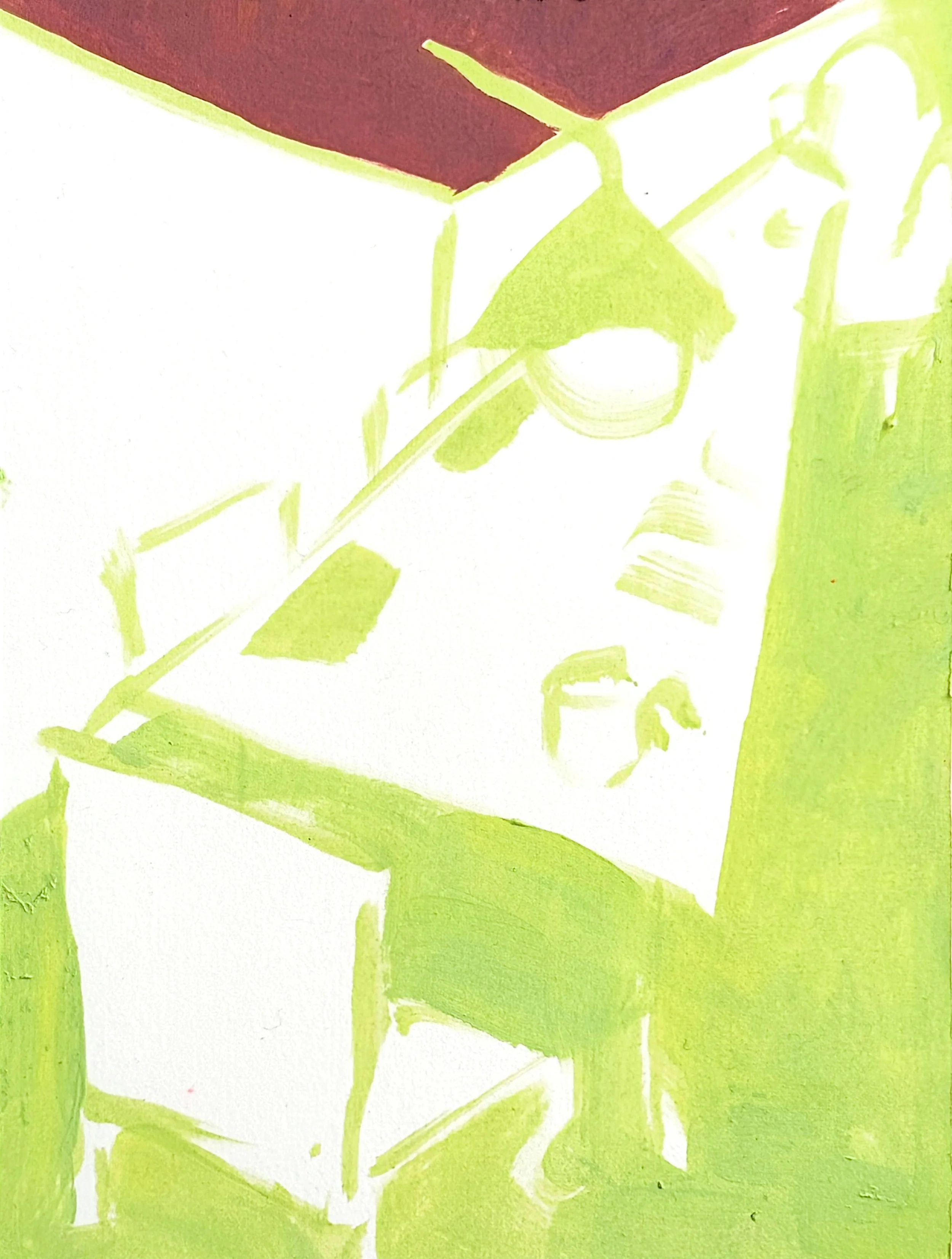
Almost, Empty Dinner Table (2025), Madeline Eldridge
You Could Be A Sportcoat
DREW JOHNSON
Hearing that Chuck Schumer, the Senator from Wall Street, would be taking over for the only good guys going, I had fallen into one of those ten-minute stupors, sideswiped by dull and familiar thoughts: what a shit he was but oh how much worse were the forces aligned against him, etcetera and so forth, to no purpose, not even interesting myself until—for no reason I could have named—the name of a friend rose up, damn near typographically, before my mind’s eye: Dumas, Martin Dumas. I’m embarrassed to say that the Bond phrasing did happen: that was how the name came to me.
Only because I can’t seem to track him down to get his permission, that’s not his real name. I’m going to call my friend Dumas, but not after that Dumas, but after another writer: Henry Dumas: look him up. And that Dumas, I guess, pronounced it, some of the time, anyway: Doo-mas.
So that’s how I expect you to do it, too.
For the names of our friends and their faces are always before us. Only not my friend Martin. Whenever I thought of people whom I’m unable to surveil on Facebook, Dumas topped the list, a list most of us can tick off of the most curious people you’ve known, self-selected, but not really together. The last email address I had, when I checked, ended in A, O, and L.
But the last time we spoke was a lunch pleasant enough that it turned into a walk with momentum enough that we rounded it off with a couple of drinks. Whether he was conscious this was our last time sitting across a table, I was not.
At the outset, I should say I made no notes and can’t even perfectly recall Martin’s voice. In fact, these are the notes: a kind of moral incident report three or four years after the fact. If I were an informer, this is what would be on file. If there was any statute that was actually violated? Some New England blue law penal code of conduct, maybe?
But although I wrote nothing down at the time, I’m recording more and more, so some of what Martin said he must have felt strongly about, for he emailed me more than a month later to amend and clarify what he was worried he’d said. Which was just like him, to be honest. He worried, Martin, enough for several of us, which may have been why we kept him around.
I haven’t simply slapped those emails in wholesale—that didn’t seem polite—so this is a composite. There are places where this narrative will crack, but when you run your hand across it? Your hand will run smooth. Nor is this some kind of medieval witch-and-water test I’m talking about: even the truth, the truth in the moment before your eyes, will break—under enough stress.
When I asked him what he’d been doing, he said, I’ve been teaching at a prison. Sure, I said, and I’ve been trying to work for a political campaign. Turned out neither of us were kidding. So, to take each other seriously, we had to start over. Which was awkward. You mean you’ve been volunteering, Dumas countered, dressing his coffee. That’s what I said, I said to him, but I hadn’t and he was right.
But although a special election for the Senate seemed like an interesting opportunity—although I wasn’t sure for what—the campaign was pretty closed off. There were a lot of the state people from the election prior in which they lost the seat to the other side. One of the first conversations I had was with a carried-over-from-the last campaign fundraiser, giving me in turn what seemed a prepared speech she’d had to give so many times since that defeat, We feel badly, all of us who were on the Attorney General’s campaign. We wish we could go back, do a few things differently. We feel like we lost the seat. We want to get it back. Sure, was all I could find to say. She continued on, delivering these lines to each volunteer, and so was nicknamed Regretsy by the end of the first month. Dumas looked bored just then, as was his way, and cut through my narrative with a question.
Stop. Just stop. What was the one day, Dumas asked, I’d always carry with me? From that whole campaign? That’s easy, I told him. So tell me, he said. I worried for a moment because Dumas wrote sometimes. Without much success, but plenty have been blindsided into being the successful subject of unsuccessful writers. But all of us always wanted to hold his attention. So I told him about the big house on the hill west of the city. I don’t know what he thought of what I told him, but he asked me about it again, later, in a text.
What would I say about that day as a cross-stitch sampler?
What?
A cross-stitch sampler? Of that day? What would it say?
I’ll have to get back to you on that.
When I got back to him, it was in all-caps: VICTORY IS MANY THINGS BUT VICTORY IS ALWAYS FIRST A FUNDRAISER. I like it, Dumas replied, three words, maybe the last text he ever sent me. He wasn’t in my phone so he just showed up as a number.
What I told him then and what I remember now are of course different things but the short version is that I drove out to a house west of the city, a falsely restrained three story bungalow, like Gatsby had tried to build something modest and failed. A solarium stretched across the back almost from what could’ve been called an east wing to what was called the ballroom. In my first ten minutes there, I had to duck out of a group of volunteers, because Regretsy was recruiting valets for the parking. They were expecting a few hundred at a few hundred dollars a plate. Despite all the glass, I didn’t want to spend the evening outside looking in. She was picking only men and I didn’t feel like conforming.
The room I ducked into was cozy by the standards of that house, book-lined with a fireplace and a single window. Narrow, to sandwich that heat in on grey days when the winter drove you out of the ballroom and the sun couldn’t do anything with the solarium. On the shelves were paperbacks from someone’s radical youth: Dick Gregory, Frantz Fanon, Erica Jong, Vonnegut, and Mailer. Brecht and Sartre for days. That was the heart of it, although I could go on. I wish I’d made a long, panning smartphone film of the shelves because I’d watch it now to remember just how pressed together the paperbacks were, shoulder-to-shoulder, preserving, but that was all. When I ducked back out of the room, the men were mostly gone down to the parking lot and so I became one of a pair of doormen.
The arriving guests, old and older, were mostly lovely. They filed in, their coats taken by Regretsy and two volunteers. The way the volunteers took the coats was studied but informal, as though they were known-forever daughters greeting old family friends.
The catering company came in the through the solarium, from which much of the new, modern kitchen had been usurped. Darkness revealed paper lanterns along the walk and frantic cell phone conversations promised the candidate any minute now. Regretsy sent me into milling ballroom on the relayed report from down below of a Lexus with lights left on. Too loud for an announcement, I approached one trio of elderly men. They had found each other, it seemed to me, because they were all still strong, square shouldered men, able to drink and look clearly at one another. Excuse me, I said, and recited the plate number.
That’s my car, said one man, one of the three men, in a room of several hundred.
My God, I said to him, you’re the first I asked.
He clapped my shoulder, That is lucky, handed me his drink, and went toward the door and his car. Another of the three men called after: his luck or yours? An overdressed couple flitted by, younger by twenty years than anyone under the roof not claimed by campaign or caterer. Someone said that was the nephew of the house and his willowy fiancée in her spring-colored, trailing gown. His head was a bullet and he wore the evening’s only tux. By the time the candidate arrived, everyone on the campaign referred to the pair as Mr. & Mrs. Bond.
Slowly, I backed away from the Lexus men into an upright, taxidermized black bear. Gently, the bear rocked on its stand. Silently, I asked the bear not to be real, not to be standing there. Carefully, I placed the Lexus man’s melting highball on the bear’s silver platter.
When the candidate finally entered, she was surrounded. For the first time, I understood who the hostess was, watching her find her way through her guests to the candidate, then speaking to her, a little hunched, confidential, preserving her moment. The host hung back, nervous and radiant, his suit in expensive disarray, frothy blonde hair high toward the high ceiling.
The doors to the ballroom closed. Outside, we could hear Charlie Brown voices, but that was all. There was nothing to do. There should have been nothing to do. Standing on post with the other doorman, we smelled the smoke about the same time. Frowning, we went along the hallway trying to suss exactly what was going on. The door to the small radical library opened and the Bonds swept past us, guilty. Smoke wafted strongly after them. We pushed in together. The young pair, perhaps tired of speeches, had started a fire but didn’t know to open the flue. We opened the flue and a window and waved a couple of museum catalogs until the smell no longer made us cringe.
I couldn’t believe they’d started a fire and then just run when it went bad. I was pole-axed by it for the rest of the evening. Even now, I wish I could sit down and talk to them both, ask them how what they’d done made any sense at all?
Because they knew you—or someone—would clean it up, Dumas said, and how could I deny it? Should I have let the house burn down? It would be a start, he replied.
But I stayed on the periphery, where things made less sense, for the duration. Hard to get anywhere near the candidate, really, that night or anytime. The paid people were all working with each other and the paid people below them were all kids recruited for the summer from Harvard. So there was that remove on top of another remove. She herself was—she is—exceptional, of this I have no doubt, but she was surrounded by what wasn’t, albeit at the highest level.
All this I wondered aloud to Dumas.
How much can you really do under those circumstances? How much can she? Strangled in their image? Does the exceptional at that level really outweigh the rank and file of upper-echelon mediocrity? Lapsing into mediocrity so quickly and quietly we don’t even notice. Quick, someone do the cost/benefit analysis on a cocktail napkin.
You’re getting hysterical, Dumas told me.
I don’t know if I really think that.
Maybe it’s just what you are to them and what you are to others. You know?
I said I didn’t know.
Maybe we’re someone else’s mediocre obstacles?
We’re both unemployed, I said.
When I said this, Dumas had been scanning the whiskey menu. Wistfully. He shut the menu,
So now you listen to me for a minute. Okay? This is my one day. That I’ll remember. What I asked you. You: from the campaign. Me: from the prison.
Dumas told me there was a delay in the required safety briefing meant to tell Dumas all the things needed to teach inside the prison. Not the rules, but the thoughtful things requiring a voice to stitch them to reality. The rules, printed and bound, were mostly about what sort of clothes could be worn through the airlock. No underwires for the ladies and so on. Dumas read through the rules but wound up over-dressed compared to his cohorts. Business casual Dumas to their blue jean Fridays.
In the classroom, too, he was among convicts with their own set of rules. And, much more than among the other teachers, he was conspicuously overdressed. The prisoners wore mostly sweatpants, t-shirts, and white sneakers. They were clothes which demanded you slouch and lounge in the school desks provided. So they all did, teachers, too.Slouching in Sunday School the photograph of them all could’ve been captioned. Though, of course, photography was strictly disallowed. The teachers’ cellphones in lockers waiting while they taught. Most of the prisoners had never seen a cellphone outside of television. They had never been on the internet themselves. Aside from what came to them via satellite, the present was a science-fiction future, and their world not much past 1998 or so.
Dominating the class were three old converts, black men, who’d all taken the name of the Prophet’s murdered grandson Ali, the victim of bloody Karbala. One from Philadelphia, one from Delaware, and one from one of the Carolinas. The oldest was shiny bald, the middle was dour, non-descript, while the youngest wore a head of not quite grey dreads. Dumas slouched opposite the semi-circle of men, and they slouched back.
Slouching helped when listening to their work read aloud. They were as good a group of writers as any class might be, but the magnitude of what they were forced to try to convey was—with rare and wonderful exceptions—mostly beyond their skill: mostly beyond anyone’s skill, maybe. So of course, it helped when any of these writers seized upon the terminology, the routine, and the very how-to of their world. Others ran in the other direction, to orcs and elves. We pushed terminology and routine.
What he was reading wasn't very good, but it was interesting. That's so much of the whole thing, isn’t it? But it made it hard to teach in prison where—if you could leave—everything was interesting.
As, for example, when the oldest Ali’s essay touched on his wife at home. Her latest sportcoat, he read, and Dumas balked.
A sportcoat, is that what you said she said? Was that what Ali had said? Wait, stop, Dumas interjected, What’s a sportcoat?
The ring of men chuckled in their children’s desks.
Though it was the oldest Ali who’d been reading, it was the youngest who theatrically turned his head from the reading Ali toward Dumas, his dreads swaying a bit past the point where his head stopped.
But one of the other prisoners spoke first, All flash and dash and good for—
The middle Ali cut him off. No, you’re not telling this.
Young Ali began, without acknowledging the interruption, Your woman gets lonely. She divorces you or doesn’t divorce you. Maybe even her own family doesn’t come round as much now that you’re in here. If she doesn’t divorce you or if your kids is old enough that you’re still all over that place even if you haven’t been there in years. Even if nobody talks about you. Maybe then she falls in with some man or men who’re just worthless from the get-go. Oh, now he looks good—that’s right—and maybe he likes nice clothes. Maybe your working wife buys him some more nice clothes. Maybe he doesn’t work but he tries to help out or maybe he doesn’t do that, either. But he’s around. And you’re not. Whatever you were, was, ever, or is—he beats you at the buzzer with that. Every single time.
Ali paused, smiled to himself. Looked at Dumas so that everyone saw him look: wingtips, trousers, button-down, sweater. Looked at him until everyone had seen him looking.
Then said to Dumas, his diction at deliberate intervals, musical, amused—like a falling scale on a muted xylophone, You could be a sportcoat.
And they had all laughed, even Dumas. The idea of advantage played to the hilt was a tragic one. Maybe everyone ringed round the king was a fool and maybe you were wise but how were you going to get to the king or your wife or god? Maybe you had to die first. So they laughed.
The drive home from the prison along old roads through small towns and village commons and closing farmer’s markets, their tents still pitched over nothing, was more beautiful than it had ever been, more absurd.
Dumas didn’t need to tell me that the third Ali had landed a blow. Prisoners were, by profession, great students of human behavior. Without knowing for sure, he’d punched right into the fact that Dumas was unemployed while his wife—whom Dumas hadn’t mentioned and I hadn’t asked after—was not. Dumas was there, but for how long, and why? And although I had never heard the word sportcoat firsthand (and most likely never would) I felt a bit on the spot myself. Someone had already left me.
The prison where Dumas taught was for prisoners whose crimes reached a certain height or depth, so that within the tiered hierarchy of prisons and prison amenities and their only coinage—years of good behavior—this was as high as you could go. If you’d killed a man, say, when Carter was president, you might be there now, with vegetables from a small plot and the sense of the changing seasons in an early morning run and a chance to string words together for yourself, a few fellow murderers, and a teacher such as Dumas. Not that he ever knew their crimes—you were supposed to steer clear of that in conversation.
The oldest, first Ali had given Dumas another letter and he had carried it out through the airlock, not even feeling the threat upon him. You can get used to so much. This was nothing.
Another letter? I stopped Dumas. Wait. You delivered letters for the prisoners?
Just one. One prisoner. One letter. A few letters. Dumas had said more than he meant to. I am getting ahead of myself.
We went Dutch on the paycheck, but Dumas tipped a bit more than I did. We started walking. But before we resumed talking I got to thinking. Being unemployed will make you ruminative—a starvation response—and Dumas’ three Ali’s put me in mind of a travel video I’d been watching and re-watching about that time the year before. I’d checked the dvd out of our small, brick library. Outside there was a polished stone ibex and a pair of bronze pelicans—as well as a bronze porcupine wearing a raven mask. We were lucky to have such a library.
The travel video was shot in what turned out to be a window decade where, with a bro-ish young Scotsman as guide, a camera crew could move from Karachi up to Lahore and to the Khyber pass, then farther still to the Karakoram Highway. Ultimately to a mountaintop where the mesmerizing world music theme kicked in to close the travel parenthetical, and the credits rolled. But before then, they pass through a Shia area on the day of Ashura. Commemorating murdered Ali, grandson of the Prophet, the men take to the streets bearing chains tipped by blades. And although there are ambulances standing by—tingeing the eternal with the social safety net—there follows footage of self-flagellation and the streets puddling blood. Quiet, our guide shares his alienation from this ritual, then presses on to the Western freedoms of other people’s mountains. In my idleness, in my newly named sport-coat-ed-ness, I had watched the video several times and, after that lunch with Dumas, went to watch it again—thinking of the three Ali’s in a prison in Massachusetts: in their renaming why did they choose to commemorate the murder of Ali, the closing of that mystical mind?
And I couldn’t say that a bloody Ashura didn’t put me off, too. But this was years ago; the sort of cultural spectacle I was likely to see on film quite easily, while the footage shot from my drones or shot of my aftermaths that was aired on networks all over the world was much harder for me to see in the town with the small brick library. What’s the old adage: if it bleeds, it leads? Yes, but whose blood?
At the briefing Dumas and the others were finally given, the retiring supervisor of recreation told them—looking very tired—mostly what you’d expect. Save two things Dumas could still remember to tell me years later. The first, because of the way the man put it:
They may seem like the nicest guys in the world. I hear that all the time. I feel the same way a lot of the time. Just remember, on one day, they weren’t.
The second because it mattered later:
An inmate will ask you to do something totally innocent. He’ll say somebody’s got to get this letter I forgot to send or they won’t let me send. It’ll be my-innocent-mistake or their-bureaucratic-bullshit. Pardon me, B.S. (I’m retiring). Regardless, it’ll be something no one in the world feels comfortable saying no to—even though, ladies and gentlemen, those are the rules. Let me repeat: those are the rules.
He stopped and took the time to look most everyone in the eye,
And because those are the rules, you’ve just joined a little club, a conspiracy: you and the inmate. Only now he’s got something on you. Because you broke the rules. He did, too. But he’s in prison. Now, he’s kind of got the edge on you. Because if you come to us and tell us, hey, I’m sorry, I mailed this letter, we’re going to kick your ass down the road—pardon my French—we’re going to kick your organization out and tell them why and that it was your fault. If it’s something that really gets us riled: like an apology the wife of the poor-son-of-a-bitch he murdered thirty years ago when you were watching the Smurfs? Then we’re going to charge you with a misdemeanor.
But Dumas was Dumas. And later that same day, the oldest Ali waved him over.
Hey, I wanna ask you a big favor. I didn’t get this card in the mail—and now they’ve suspended mail. That’s some bullshit right there. My grandson. His birthday. You don’t have to do a thing. Just drop it in the mail in town on the way wherever you’re going.
And Dumas took what he was handed.
Why’d you do it?
Dumas stared at me.
I don’t know.
And I didn’t push him.
Dumas dropped it in the mail two towns over, thinking that maybe that was safe, or safer. Old Ali didn’t even look at Dumas the next time, but after the next class he came right over and just said, Deliver this for me. Take it there yourself.
Or you’ll tell them.
That’s right.
Who is she?
It’s not so bad. She used to be a teacher here. Like you. No, a lot better than you.
You’re not asking a favor anymore, are you?
I’m not.
So tell me this: how will you know if I just tear it up? If she doesn’t write back.
Because I’m going to ask you what she looks like. What she says.
Maybe I’ll just look on Facebook. Find her there. Make up what she says.
Lemme tell you: I’ve never seen a Facebook, but I’ve heard enough about him to know that I wouldn’t mess with it. Neither would she. Be with the Facebook.
Not with it. On it.
That’s right. Now you give her a good look and listen close. I don’t want anybody to get in trouble.
Out the prison’s pat-down airlock, Dumas sweated. All the way home he fretted. He left the envelope in his car so as not to have to be in the same room with it. He mapped out the address and didn’t sleep at all.
She answered the door without surprise and listened to who he was. She had left him in the mudroom foyer of the two-decker house, which should have been a family on top of another family, but had been poorly renovated into one house with this basically public space as the hallway between. In fact, the only sign of renovation he could see was that the doors were off both entrances. The draft in January must have been brutal. This was January, Dumas remembered, though only just. The draft wasn’t brutal. Breathing out, he couldn’t see his breath.
Hanging in the foyer, facing the staircase to the twin apartment above, was a massively tall cross-stitch framed and under glass that began above the small table where keys and gloves and junk mail resided and ascended almost up to the landing above so you were tempted to begin reading at the waist level. So absurd that before he finished reading it, Dumas pulled out his phone and took a picture so he could prove he had seen it. Several pictures actually: size, angle, and glare or glass combining to keep him from getting the whole in one. Taken together, the following words were stitched:
I know that this will sound strange in many ears, and will be especially startling to those who have considered the subject chiefly with reference to painting: for the great Venetian schools of colour are not usually understood to be either pure or pensive, and the idea of its pre-eminence is associated in nearly every mind with the coarseness of Rubens, and the sensualities of Coreggio and Titian. But a more comprehensive view of art will soon correct this impression. It will be discovered, in the first place, the more faithful and earnest the religion of the painter, the more pure and prevalent is the system of his colour.
It will be found, in the second place, that where colour becomes a primal intention with a painter otherwise mean or sensual, it instantly elevates him, and becomes the one sacred and saving element in his work. The very depth of the stoop to which the Venetian painters and Rubens sometimes condescend, is a consequence of their feeling confidence in the power of their colour to keep them from falling.
They hold on to it, as by a chain let down from heaven, with one hand, thought they may sometimes seem to gather dust and ashes with the other. And, in the last place, it will be found that so surely as a painter is irreligious, or obscene in his disposition, so surely is his colouring cold, gloomy, and valueless.
THE SEA-STORIES
JOHN RUSKIN, 1853
Up and down the long sides of the cloth margins were climbing green vines with station stop pink roses of complicated structure. Also, floating at intervals so that there were perhaps three times as many roses as these other, hovered deltas of brownish blackish thread, stitched and coiled to conform into a living triangle.
The thread of letters, roses, vines, and triangles—was it thread in cross-stitch?—was coarse enough to seem faintly hairy itself and was then hairy again with dust. Under the dust, the colour was noticeably faded. Colour? Color, thought Dumas. I’m not English.
She invited him inside. Tall, but made taller by the long, grey braid that roped from high on her head to somewhere south of her waist. She was older and she had done nothing to disguise that. Dumas said I wouldn’t fixate on what she looked like only the third Ali asked as my test, and she, she told me so little. She gave me some tea but drank none herself and sat me down in a bay window breakfast nook. Don’t repeat her name, Dumas asked me. I’ll make one up, I said, (but I haven’t yet).
I hope you didn’t go to too much trouble to bring me this.
Wasn’t much my choice.
She smiled, but not at me. I understand: I taught there, too.
Which was how you met.
That was how we met.
So you can’t correspond normally.
Use this for your teabag, she said and slid a coaster across the tabletop.
Do you have any message for him?
I don’t like to put you on the spot.
Actually, it would help if I have something for him.
Do you mind sitting while I write something?
Dumas didn’t. He flipped through a magazine about farming. Not gardening, but farming. Then one about sheep. There was so much to know about sheep. There was an article about gathering the wool that blew like tumbleweeds and caught on the barbed-wire fences. There was something that made Dumas remember that, something frugal, like the woman who’d gone to write her note and handed it to him, presently, sealed.
What the notes said? Dumas never read, but it would have been better if he had, wouldn’t it? What were they to each other that their loss meant so much? Star-crossed? Dumas thought that was too much: they were close, intimate, that was all that was clear. To make it any clearer was no longer something he could do or I could know. Even if it were true, it would still be bullshit.
Later, Dumas quit, after five or six letters each way. Quit teaching to quit the illicit mailman routine.
On my end of things? The campaign? She won. Did I say so?
Later still, on his end, they closed the prison: consolidation. Old prison and older inmates. If you can think like we all think when the future concerns us directly, that is, with a fairy tale gauze predominating, you might think for a moment that if you had worked your way—through good behavior—to a prison and that prison were to close, you might be released. You would not also be asked to give up that library, those small gardens, that gym, your bunk, the locked but familiar cell door, those neighbors, friends, lovers, even teachers, even guards of an uncertain but hard-won rapport: if these were taken from you, you might go, too. Instead of beginning again at, let’s say seventy, with only the rest of your life to order what you could order of such disorder by design.
They closed that prison, where (true story) the leading man from Zabriskie Point, Antonioni’s 1970 counterculture film flop, died. Played a radical, became a radical, a little bit of armed robbery for the cause and then there, in those walls. He died in the rec room he never had to give up, lifting weights with no one spotting him early one morning, the shaft of the solid bar across his windpipe. Nothing suspicious, they’d said.
Dumas told me that over drinks.
I asked Dumas if any of the old guys, the three Alis for example, had known him?
Found out after I taught there, that the Zabriskie guy died there. Never had a chance to ask.
That’s a shame. What happened to the woman from Zabriskie Point? I know you looked that up, too.
I didn’t. Dumas leaned back. Our time together was drawing down to nothing.
I pulled my phone out. The bartender came over with the check. Dumas waved me off. I let him. I clicked Zabriskie Point (film). I clicked Daria Halprin. I clicked and I scrolled. Dumas looked around the room.
She married Dennis Hopper.
But that’s not all.
No, but that’s what jumps out.
Give me that.
And I gave him my phone, an increasingly intimate gesture, mostly because of his tone, a little frustrated. We sat, waiting for the check, Dumas reading and me still toying on the math of which fate—prison or Dennis Hopper—seemed worse.
Later, he emailed me:
Imagine that. Imagine making peace with the idea that this wall you were looking at out your window was the angle of sunlight you’d see for the rest of your life. Or the angle of moonlight. Then to lose that, too? There’s this Rilke letter I never shared with them, though I printed it out and tucked it into my notebook to take along. To smuggle in to them:
But the promised, smuggled bit of Rilke was neither below, nor attached. I always think well of Dumas, but I wondered what kind of courier he had really made? What kind of teacher?
Only one available was the answer, sure, but if you really leaned hard, without mercy or pity, on the varied dodges hindsight offered so that the idea you could’ve done anything and/or that you could’ve done only the precise thing you had already done were both offered braided in the same breath to justify everything, well, that was usually, even almost always, true. How much of what went down in that prison has gone unrecorded? Yet here the oldest Ali and she of the long grey braid get ratted out for passing messages. If anything, I’m the one spilling secrets. About violated prison protocols on the one hand plus the not very new news that the young rich kids of the Commonwealth have no sense that other people really exist. Right up to and including burning down a mansion full of other rich people, even. But not as a political thing. Just because they didn’t know how to work a fireplace. And now? The prison is closed. I said that already? Okay. How about this: the candidate won. She’s still in office, a Senator. I still like her. Will this story really be over while she’s still in office? I don’t know. While a single one of those guys is still in prison? You tell me. Dumas did email, finally, long after I wrote the rest of this. He said to say hi.

Drew Johnson was raised in Mississippi and lived for many years in rural New England before moving to Tallahassee. His short stories have appeared in The Kenyon Review, Harper’s, VQR, New England Review, and elsewhere. His long essay on the uses and abuses of history was recently published at Longreads. Other nonfiction has appeared at LARB, Guernica, and Lit Hub, among others. He received his MFA from the University of Virginia and is at work on a novel.