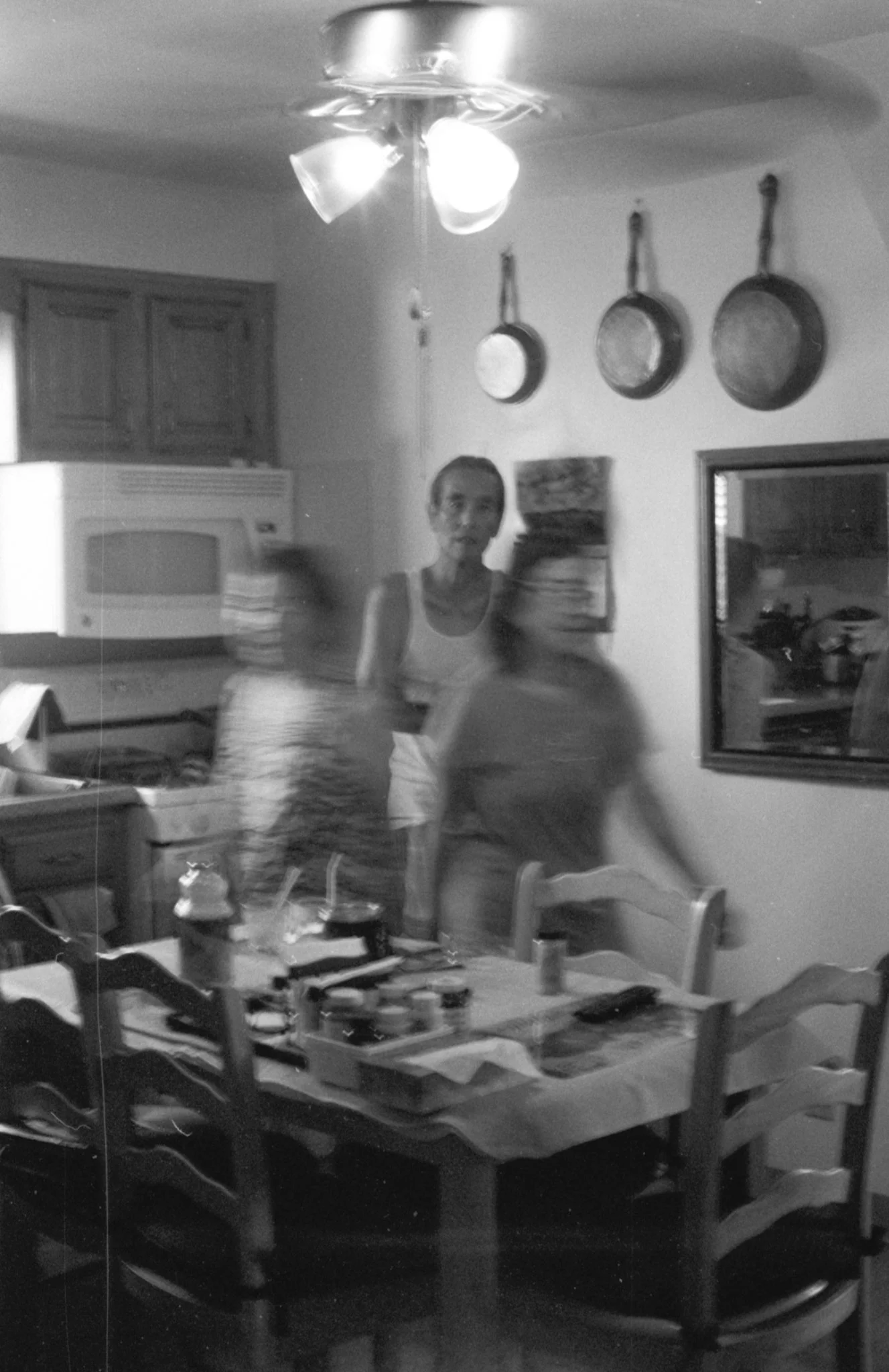
Dinner Time at Ada's (2025), Caroline Cavalier
Ithaka
Elena BOWMAN
Without her you wouldn’t have set out. She has nothing left to give you now. -Cavafy
I have been talking to Dad about the World Tree, which seems a normal thing to discuss with a dead person. The Siberian birch, the Mayan ceiba, the sacred yew at Uppsala. When I reach into the roots of my memory, it’s the cherry trees strewn with silver tinsel in my grandmother’s garden to keep the crows away like omens of despair. It’s the knotted oak that split the dirt road to my grandmother’s house at Clover Place, around which we bowed in obeisance. The line of cypress that separated our home from the graveyard a few meters away from our vegetable beds.
After the death of her eldest son, Yiyun Li wrote about the use of gardening as literary trope and personal overture. The parent/child/lover meets their untimely end, the trees grow, the David Austin roses bloom, and life chugs on, usually with the help of delicate friends. And yet:
A garden is not a shrine. Living is not metaphorizing… A garden is trustworthy only at this moment, in this now.1
__________
The blundering gummy migraine and the flight attendant with lipstick on the canines asking, What brings you to California? and you say research and she says what kind when really she just wants to flirt with your seat-mate, an airman in OCPs, and you say I’m going to see where my dad died and she grimaces at the social halitosis and fuck you should have lied and just said you were going to Disneyland.
No one knows that I am coming. I don’t want to see these people. Don’t want to be seen. I want to feel the land. Maybe because last time they saw me I had an eating disorder and was properly small, maybe because I outgrew the disorder and still regret it. Maybe because I want to protect the mythos of the place, with the churchgoers entrenched as villains and not the people who probably tried their best. Maybe because I don’t want to be the mouthpiece for my family, who haven’t been a presence in this town in nineteen years.
I’m not sure why I’ve come to Tehachapi. The Public Affairs Officer at China Lake was cautious but enthusiastic about getting me to the crash site, and the School of the Arts was likewise enthusiastic about funding the trip. The PAO promised to talk to the higher-ups. A week of waiting, while I pack bags and attend a teaching conference and anticipate how hard it could be to go back to the town, the axis mundi. I’ve been given a travel research grant to get as close as I can. I have the coordinates. Apart from the officer and my siblings, I tell no one what I am attempting. I’m embarrassed of my white-hot need. Thirty-six and still asking questions.
I get the update while I’m waiting for the connecting flight in Charlotte. The area has flooded, and there’s no way in or out. There are no trees on that ridge, nothing to break the wind and water. It’s a no-go.
It is, of course, the archetypal return.
Mom has just emailed the three of us to say that she is heartbroken, how Dad would be disappointed that we’ve forsaken our Christian heritage. It will be a hard conversation and she may not understand it, but I am in the Charlotte airport reading and rereading her words as I am headed to find and then not find where my father’s body ceased to be his body. I have unbraided my hair and am running my fingers along the scalp, tugging at the roots. I have not slept in four days. I think over and over, this is convergence.
I’m not sure why I wanted to get there, what I was hoping to find. I doubt there are teeth or tendons in the sand on Echo Ridge. I want to stand where it happened. Maybe I would feel the weight of it. I could imagine the blood soaking into the ground, pretend it hadn’t blown away. I think maybe home is where the bodies are, and even though the bodies in the Tehachapi Historic Cemetery aren’t his body, maybe the concept of the thing is sufficient. Or maybe just this is the place where the thing happened to me, the Emily Dickinson and Edgar Allan Poe of the childhood graveyard. A half a Ziplock of ash isn’t much, but we spread it in these mountains, in the breeze. Maybe I’m breathing it now.
__________
The tree is universally regarded as one of the assured haunts of deity. Ancient Egyptians worshipped a host of sylvan paramours: the sycamore, the acacia, the tamarisk. It’s likely that in early iterations Osiris was a tree god.
In many cases, the tree is that which reconnects the earthly to the sublime (the Bodhi fig tree, for example, or the twin trees in Eden), the express mechanism of provision through which the gods reach into relationship with humanity.
I am hardly a mystic, but there is something in the trees of the Tehachapi Mountain Park that is holy. Maybe I’m in love with this forest in the way Neruda was about the cherry trees.
__________
No one had to execute that first will I wrote when I was seven or eight and already dreaming of death, scrawling in a purple diary with a lock that did very little in the way of guarding my thoughts. I willed my stuffed animals to my friends and Juliana was assigned Alfred, the slouched polar bear which had been Dad’s and around whose neck I had fastened a tie, which I had learned to do for that exact purpose. I cried as I looped the cursive testament, moved by how much my friends would miss me.
[to Self, sotto voce]: You melodramatic sod.
I wonder if a bent towards the macabre plus the early loss of a parent is what sparked the particular insistent appel du vide that has followed me most of my life. The way I think of jumping off ferris wheels, stabbing myself in the uvula with a mechanical pencil. The easy slip from a subway platform. Death means less when you’ve made his acquaintance.
The way I ambled breathless through the headstones and recited each name [Goodwin Child, 1860; Clarence Benjamin Campbell, 1890; C. North, 1877 Killed in Gunfight at Greenwich; The Hale Family: Moses and Elizabeth and Martha and Mary and Tommy] and made up stories where the cause of death had been rubbed out. Too loud around others, I preferred to walk by myself, telling stories. Or otherwise, plotting and editing and reciting with those other writerly friends on walks through the woods, corduroy overall- and scrunchie-clad, picking wild garlic in the undergrowth.
In one particular copse: a lone rough-hewn wooden plank fixed between two cement corbels to keep it from falling over. The stones are floral and covered in bird shit. The stencil says unknown.
Köppen Csa says the town is a crater of bald sunshine, a lush cricket June, an Indian summer between my parents’ fence and the San Joaquin Valley. The haunt of rosemary and evergreen, a combustible hill of star thistle, patches of provocative gold.
On Labor Days, we wrapped the trees in burlap. We knew it by heart (Hardiness Zone 8), which is a funny way of saying we can take a beating but everything shivers when it’s cold. It’s the field of migrant tents at a rhubarb harvest; it’s the curious misspelling of Tucker Street (an ongoing prank of truant boys, all of whom were named Jacob).
Our garden was tilled first by two sisters, one who made rosehip ice cream and one a botanist; every inch a harbor for roses, vines, crabapples. When we moved in it became my solemn duty to care for anything that needed tending by hand. The neighborhood teenagers (much taller than I) trimmed the cypress, but at eight I was the ruler of small things: brisk mornings with a coiled hose to the roots of the cherry trees, slow Sundays lumbering over a lavender hedge and raking pine needles. I named the plants in the back yard only meters away from the dead: the Winken, Blinken, and Nod boxwoods and Hector the Stinking Yellow Hellbore and Berlioz the Birch.
Tehachapi is where we sowed early and indoors, dousing the rows of compressed clods and leaving them to expand in the laundry over a churning dryer of fresh towels. The heat encouraged seedlings to settle. I climbed down from the machine and was diligent not to touch anything with my diatomaceous fingernails.
__________
The call comes in the middle of a staff meeting. A Connecticut areacode. I miss it.
Then, on my fifteen: “Hi, Elena. I’m calling from Columbia University.”
I can’t breathe. Can’t stand. My co-teacher Sarah comes behind me to wrap her arms around my waist as I shudder. That’s the best response I’ve ever seen, she says. Play the voicemail again, so I can hear it.
We sell the piano and head northeast. Scott mounts his childhood walkie-talkies on the dashboards of our cars, old as bones. Idaho, Montana. Yellowstone. A 10 pm sunset and crystalline air. Then the yellow hang of Ontario fires hovering over Minnesota, Illinois.
How are you doing today? The sound is patchy steel wool carved in the shape of my husband’s voice. Pizza in the haze of Michigan dunes. Then the Air Zoo in Kalamazoo: Scott has found the exact SR-71B from Dad’s photographs, and I put my hands on its leathery wings. This is a gift to me, touching something he has touched.
Doing okay. Crying a little. I don’t believe in prayer, not really. I guess I don’t believe in home, either. I suppose there are days when I believe in land, in rootedness, but I suspect the only boughs still wick are the stories. Still, I talk to Dad for eight days, pausing only when I hear the buzz of Scott’s voice phasing in and out in the near distance.
My first or maybe second purchase in New York is potting soil. We had arrived in a cold rain and eat shepherd’s pie at Rory Dolan’s, where a doe-dappled waitress named Caitlyn heard me crying about humidity and unfamiliar one-way streets and brought me a cache of thoughtful welcome-to-NY memorabilia while I wept into my potatoes. Our apartment is on the third floor of a perfect cube, and twice a day I carry the planters from east to west face and back again like a worried parent. Serrano chiles, red mesclun, Jarrahdale squash, Komastuna mustard, San Marzano tomatoes, Japanese Kale, wisteria whose black-button seeds I stole from a portico in Central Park, and a single apple seed.
__________
It’s June and I’m standing in a graveyard in a hundred degrees. The graveyard, which is what I call it to myself, as though there are no others, the one that borders the driveway we once parked on. I’ve wondered countless times about the person who must have driven Dad’s white Honda Civic home from Edwards Air Force Base. He’s faceless in my memory. Did he cry on the way here? Did he practice a speech for my mother, or did he drop Dad’s keys wordlessly on the green tile counter before anyone asked too many questions? I can hear the doxology in the warming desert breath.
I don’t remember the house in this color. It’s whiter now, I think. When my parents bought it, it was more ice-blue, with neat spheres of lavender and a hedgerow of rosemary. It is a house visible from both freeway exits, the kind that says welcome to the solidly middle class. My parents and I and Juliana had lived in my grandmother’s renovated basement until I was five, then in a tiny box with a swing set on Westwood. The house on Violette was the sign of arrival, where families from church held barbecues in the back yard and neighborhood boys helped with the landscaping before I was big enough. Now the space is ravaged, stripped down to the bare clay. The row of cypress razed to make space for a motorboat, a trampoline. There is no natural border separating the house and the bodies.
The next morning, I wake early to drive past Tom Sawyer pond and then to White Pine as far as it will take me, watch the family of deer cross an empty cul-de-sac through the foxtailed scrub brush and the sweetness of June-baked pine in Mountain Park. I used to hike here before there were fences. Afternoons in the hills, notebook and cows, the chittering of neighborhood tanagers. But this is a place that is home only in the vestigial memory, not when I’m standing toes deep in the mulch under the oak trees and pampas grass. It’s here that I became auxiliary to my own life. I’m looking for a way to say: I was here, and now I’m gone.
__________
On the day Scott proposed, the two of us drove back to Tehachapi with a Costco canister of Jelly Bellies through a generous rain and a playlist of David Benoit and Yellowcard. We’ve always been like this, jazz and unapologetic punk rock. These are the undomesticated spaces of rural California: the pitiful sooted cash-only petrol station of the Mojave, lusterless baked sand frozen in all directions before the last ascension into the mountains. My hometown is called the bottom of the grapevine, dormant fields of apples sleeping away a modest winter and what the matriarchal Kawaiisu Paiute called the hard climb.
I was inexplicably eager to show him that place, the trails into the hills and the Christmas tree farm and the fields where I worked one summer among the hedges of raspberries and huckleberries, beds of purple lisianthus. Moreover: the house, the cemetery, the headstone to the unknown. I took a photo of Scott shrugging in a blue hoodie, unsure of how to pose in front of the girlfriend’s dead father’s porch, standing on what was once a bed of roses. I believed if he could see it, he would understand the parts of me untouched by loss.
__________
The kindly Playwright reaches out in November of my second year in New York. He’s been constructing a screenplay about my father’s life since I was sixteen or so, won an award or two, but mostly it’s been shelved away for some more favorable date. He emails us to ask us for a new round of interviews and says God has told him to do it.
I think of the many ways we’ve been written: the poem about me at thirteen years old published in the local paper without my knowledge, the grocery so packed with images of my father that Mom sent us in to shop instead. And the periphery: Dad’s iconic SR-71 portrait in an article on Elon Musk’s newborn son. His silhouetted F-22 in gift shops, next to Neil deGrasse Tyson’s Welcome to the Universe.
I send my email response and regret it immediately. I wonder how my family will react when they learn that I’m not interested in participating in this mythology. Juliana laughs. They can make him out to be the second fucking coming of Christ, for all I care. And he doesn’t care, either. I don’t disagree, but I also know that I will not participate in storytelling that canonizes the military or the church, and I don’t want a fictionalized character wandering around with my name on it.
I appreciate that you are trying to do something to honor my father and that you have the right to write about him as a public figure, but I’m deeply uncomfortable about having my life — in particular my very painful childhood—written about and made public through someone else’s vision, especially since in the past people have written about me and my family without my consent. If I recall correctly, the initial interviews occurred when I was a child, and the space of the intervening years have done much to color my adult perspective. I request that you do not include my name or likeness as a character in the story at all.
We have all gone through years of our very private grief being made public, and while my siblings and mother have my full support to participate as they see fit, I’d like to be excluded from this process. I don’t think that we can talk or write about my father’s death without also talking about the profound failures of our church, the fact that we lost our home, the fact that (while I can’t speak for my siblings) I am no longer religious, or a million other private traumas and vulnerabilities that are not for public consumption. Someday, I’ll find the courage to write a book and tell my story.
__________
I spend every morning of the trip driving the wayward grid, from Highway 58 to Oak Knolls, down to the red roofs of the Chavez memorial and back again. I am looking for the center of memory, headquartered in a dusty hotel where desperate earwigs climb over each other in the shower drain.
Guilty, I reach out to a few of Dad’s good friends, a couple on the city council. The wife responds that she will bring her husband, my brother’s godfather, along for coffee. He used to run the only café in town, which Dad and I frequented every Saturday morning, sipping peppermint patties and spinning my stool against the kickboard. Since the crash, he’s been mostly radio silent. When the wife arrives, he calls to beg off at the last moment.
I’m sorry he didn’t come, she says as I walk her to her SUV, help put her cane in the front seat. I think he was embarrassed. He knows he let you down.
This is a place I have outgrown.
I do not believe in home, but I believe in the trees, the central pull of the mountain. The switchback of Water Canyon Road, the ravines of white lupines and the curious cockerels in the pens at the Norbertine convent. I drive it again because I know that revelation comes in threes. I cannot see the crash site, but I can sit on this picnic bench where he sat, keys jangling from a silver carabiner. I can sense through the decades the bite of snowfall, the black plastic sled with the red handbrakes and Sean giggling through his mittens. Juliana in a French braid and the waft of burgers on this same charcoal grill, roasted buttered corn hot in the aluminum. The year Dad volunteered us to play lost hikers for search-and-rescue trainees, hiding in the crevices of the mountain.
My favorite story about the world tree comes from the Bhagavad, in which it is reversed nightly, growing its roots into the sky above. The Milky Way is the river Sarasvatī, from which it is nourished. I love the down-upness as an alternative to the predictable layers of netherworld, present/earthly world, and floating but distant realm of gods and saints.
He isn’t here. I’m not sure why I thought he would be.2 But I put my hands on the old skin of the stoic pines, which are here and will continue to be here, framed by pockets of miner’s lettuce. It’s not an encounter of the sublime. It’s the warble of the vireo, the nuthatch, the junco, the dove; the sap on the fingers. The rootedness, the crust of the earth split open. Living is not metaphorizing; it is just this moment, just this now.
1 “What Gardening Offered After a Son’s Death,” The New Yorker, 2023.
2 YiYun Li: “Has anyone been able to define, capture, or even get close to a black hole?”
Elena Bowman is a Literature teacher and writer from CA. She has recently been named a finalist for the DeBiase Poetry Prize and The Florida Review Editor's Choice Award; she was also longlisted for the Exeter Short Story Award. Other publications have included the Comstock Review, Anthrow Circus, William & Mary, Cleaver, and Cosmo. An essay on C.S. Lewis and Madeleine L'Engle is forthcoming from Johns Hopkins, and another on Christian Nationalism has recently been placed at WashU’s Spectacle. She currently live in NYC, where she just graduated from the MFA of Non-Fiction at Columbia University and was recently chosen for SOA Dean’s Research Travel Grant. Last summer, she joined the Columbia Artists Teach (CA/T) staff to develop and oversee new curriculum for neurodivergent writers and teachers; she teaches at a local school for the twice-exceptional, so that community is especially dear to me. She’s participated in workshops and fellowships at USC, UChicago, the Rockvale Writers Colony, Bischoff, and the Kenyon Writers Workshop; she have also been awarded a scholarship to the Centrum Residency for this Fall. This year, she was named a semi-finalist for the American Literary Review Nonfiction Contest and a finalist for the Washington Square Review New Voices Award.