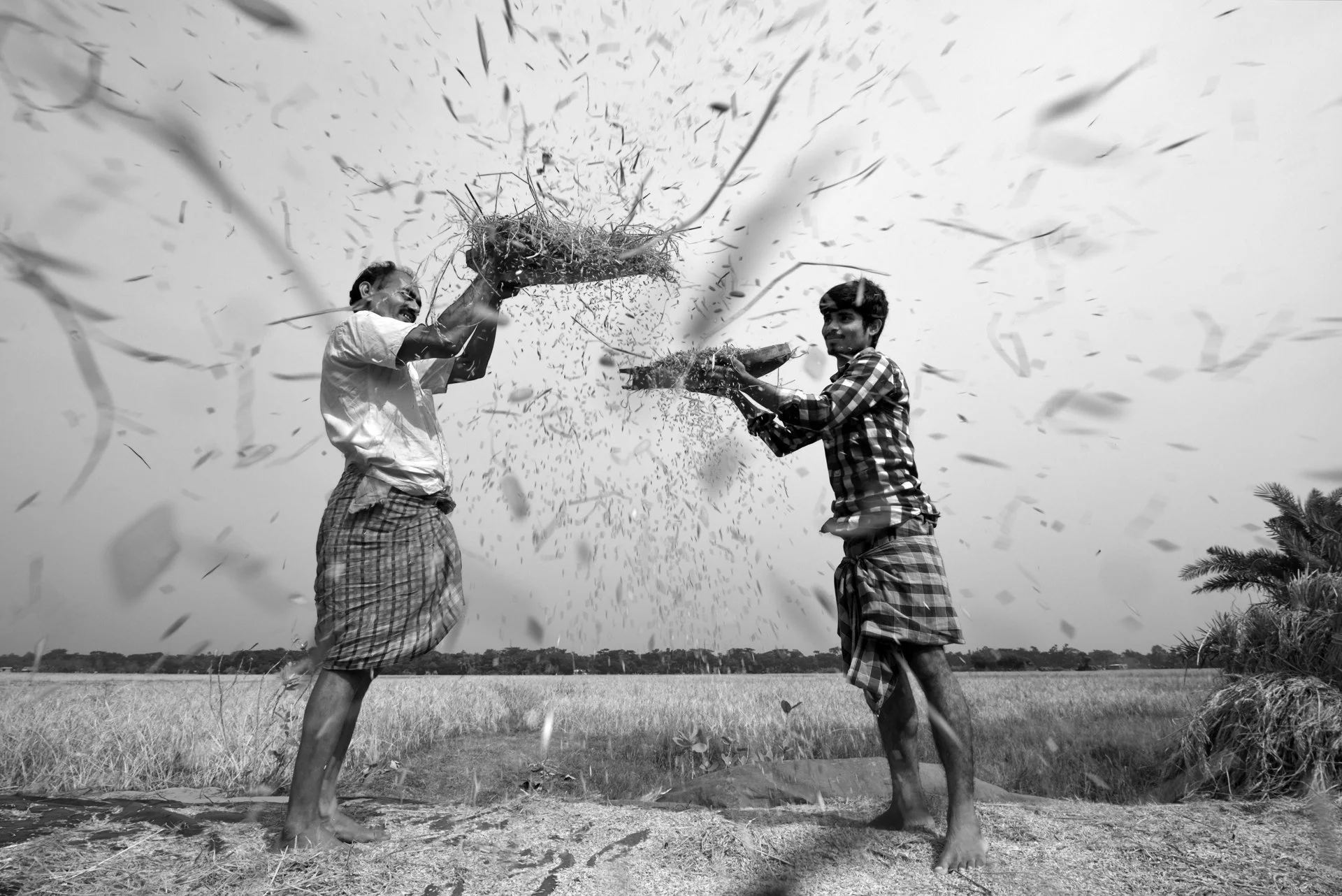
Between Light and Life (2025), Rajesh Dhar
GLUTTON
adeeb chowdhury
When I am seven years old, my father tells me that for every grain of rice I waste, a snake will come and eat me in Hell. I never ask anyone else if this is true, because I don’t need to. When humans try to stuff the enormity of God into a little box that they can fit in their heads, that box often ends up shaped like a father. I am a child of my father and I am a child of God. I understood the latter only through the former. To disbelieve one would be to cast doubt on both.
I certainly believe him as we shovel clumps of white rice into plastic bags with our bare hands, trying not to look at the sand, dust, and grime from the train floor that inevitably makes it into our food. A passenger had spilled their lunch and left it there. Once they disembark, their sandals crushing the scattered mounds of rice underfoot, out we scamper. Me, my father, and another man who sleeps in the luggage hold with us, clothed in rags that barely cover his protruding ribcage. He seems content with scooping up a handful or two, but my father and I linger on our hands and knees. Every grain, my father said. My fingernails dig into the dirt-stained linoleum like pincers, squeezing themselves around every morsel of food scattered among the candy wrappers and muddy shoeprints. Every grain.
After dinner, I lie on a wool blanket with my bare back sweating against my father’s, the rice and water churning inside me in sync with the chug-chug-chug of the New Bengal Express. Once I fall asleep, I dream of punishment. I had left a grain of rice on the floor of the train. It had been too small, and I didn’t see it, or it had been too dirty, and I didn’t want to. The Hell I dream of is a hole in the dark. A blank and spaceless pit that I try desperately to claw out of, but out doesn’t exist anymore. After an eternity of sitting and rotting, deaf and blind but my mind excruciatingly intact, I feel the snake arrive. It slithers on its belly across an invisible floor, tracing a slow and winding path through the nothingness, its tail so endlessly long that it disappears into the void. My heart thumps into my throat in sheer terror, but my bones have calcified into rock and my eyes strain painfully against their sockets. I cannot move or scream or breathe. The snake coils around me, as silent as it is patient, its scales dry and abrasive like sandpaper. The silhouette of its head approaches mine, its jaws unclasping and opening so wide that all I feel is the humidity of its breath and all I see is a darkness blacker than my Hell.
I wake up thrashing and flailing, my father’s name on my lips. Go back to sleep, he says.
Years later, the firebombing of Dhaka reduces its trains to charred skeletons. A surviving bridge becomes the roof over our head, and we subsist on foraging in the neighboring woods. Hushed meals of sassafras roots and birch bark ground into an almost-sweet paste by our bony, unskilled hands. One December morning, my father returns with a limp animal whose teeth and tail I do not recognize. Its fur smells like hot paraffin as it blackens over our fire. With each swallow, my teeth dig into the inside of my cheeks, and I can almost feel the strange meat bristling and bubbling against my throat. In the flickering firelight, my father stares straight ahead, his jaw working furiously to grind the semi-cooked carcass, its colorless juices trickling into his beard. The only expression that registers on his face is disgust; not at the meat, but at me as I lurch forward and heave out my breakfast. What a waste, he mutters.
In my dreams that evening, a snake lurks in the dark and watches me gnaw on warm, smoking meat that smells like paraffin. I wake up gently chewing on my knuckles.
Two decades later, my father dies. A local imam, one of the few villagers who had kept tabs on the aging hermit, gives me the news. He says that he died the way he had lived for years: propped up in a chair, staring noiselessly at an empty wall, decomposing in place. I ask the imam whether anything in the word of God says that a snake will eat you in Hell for every grain of rice you waste. He looks at me in bewilderment.
I return home to my wife and daughter, who enjoys finger painting and playing with a baby turtle that had crawled out of a drain pipe during a rainstorm. I sit at our rickety table and watch her slurp rice, lentils, and poached eggs out of a bowl. She grins at me with yolk and daal smeared across her lips, little vegetable bits dribbling out of her mouth as she tells me about her turtle. Her appetite meets its end before her dinner does. My eyes remain glued to the remnants of her food, flecks of egg white and grains of rice swimming in yellow-green soup.
That night, I dream that a giant is eating me. When he opens his mouth, the darkness is of cosmic proportions, engulfing me in its entirety. He bites off my limbs, his mountainous jaw rumbling like thunder as he chews. He gnaws at my bones and rips every morsel of meat off my skeleton. The giant is neither malevolent nor hungry. He is scared. I can see it on his massive face, with wrinkles like sand dunes and a beard like a graying, rotting jungle. His eyes are like those of a fearful child: darting, avoidant, watery. I ask him to stop. He tells me to go back to sleep.
I wake up, and all I feel is full.
Adeeb Chowdhury is a writer from Bangladesh. Recognitions he has received for his writing include the James Augustus Wilson Writing Award, the Skopp Award on the Holocaust, the Feinberg Undergraduate Research Prize, and North Star's Best Nonfiction Award, as well as short fiction awards from The Olive Branch Review and Empyrean Literary Magazine. He currently lives in Binghamton, New York, where he works in wealth management.